 |
CCPP SciDoc v8.0.0
v8.0.0
Common Community Physics Package Developed at DTC
|

|
|
CCPP SciDoc v8.0.0
v8.0.0
Common Community Physics Package Developed at DTC
|
|
This is three-layer thermodynomics sea-ice model based on Winton (2000) [197]. More...
Functions/Subroutines | |
| subroutine | sfc_sice::sfc_sice_run (im, kice, sbc, hvap, tgice, cp, eps, epsm1, rvrdm1, grav, t0c, rd, ps, t1, q1, delt, sfcemis, dlwflx, sfcnsw, sfcdsw, srflag, cm, ch, prsl1, prslki, prsik1, prslk1, wind, flag_iter, use_lake_model, lprnt, ipr, thsfc_loc, hice, fice, tice, weasd, tsfc_wat, tprcp, tiice, ep, snwdph, qss_i, qss_w, snowmt, gflux, cmm, chh, evapi, evapw, hflxi, hflxw, islmsk, errmsg, errflg |
| subroutine | ice3lay |
| This subroutine is the entity of three-layer sea ice vertical thermodynamics based on Winton(2000) [197] . | |
This is three-layer thermodynomics sea-ice model based on Winton (2000) [197].
The model has four prognostic variables: the snow layer thickness \(h_s\), the ice layer thickness \(h_i\), the upper and lower ice layer temperatures located at the midpoints of the layers \(h_i/4\) and \(3h_i/4\) below the ice surface, respectively \(T_1\) and \(T_2\). The temperature of the bottom of the ice is fixed at \(T_f\), the freezing temperature of seawater. The temperature of the top of the ice or snow, \(T_s\), is determined from the surface energy balance. The model consists of a zero-heat-capacity snow layer overlying two equally thick sea ice layers (Figure 1). The upper ice layer has a variable heat capacity to represent brine pockets.
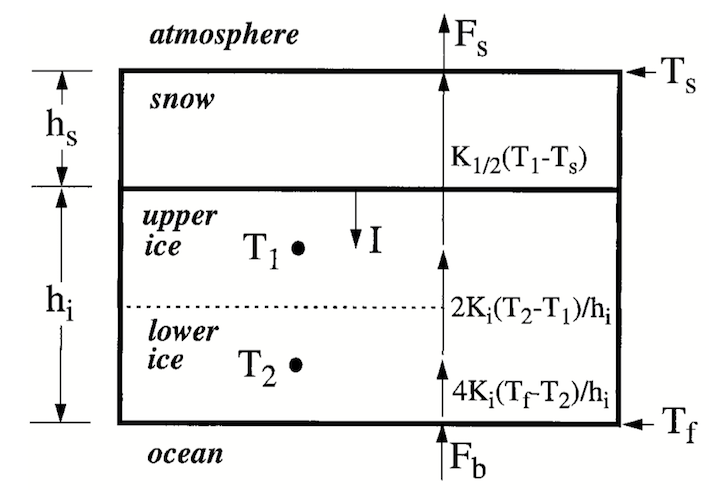
The ice model main program ice3lay() performs two functions:
| subroutine sfc_sice_run::ice3lay |
This subroutine is the entity of three-layer sea ice vertical thermodynamics based on Winton(2000) [197] .
Definition at line 460 of file sfc_sice.f.
Referenced by sfc_sice::sfc_sice_run().
| subroutine sfc_sice::sfc_sice_run | ( | integer, intent(in) | im, |
| integer, intent(in) | kice, | ||
| real (kind=kind_phys), intent(in) | sbc, | ||
| real (kind=kind_phys), intent(in) | hvap, | ||
| real (kind=kind_phys), intent(in) | tgice, | ||
| real (kind=kind_phys), intent(in) | cp, | ||
| real (kind=kind_phys), intent(in) | eps, | ||
| real (kind=kind_phys), intent(in) | epsm1, | ||
| real (kind=kind_phys), intent(in) | rvrdm1, | ||
| real (kind=kind_phys), intent(in) | grav, | ||
| real (kind=kind_phys), intent(in) | t0c, | ||
| real (kind=kind_phys), intent(in) | rd, | ||
| real (kind=kind_phys), dimension(:), intent(in) | ps, | ||
| real (kind=kind_phys), dimension(:), intent(in) | t1, | ||
| real (kind=kind_phys), dimension(:), intent(in) | q1, | ||
| real (kind=kind_phys), intent(in) | delt, | ||
| real (kind=kind_phys), dimension(:), intent(in) | sfcemis, | ||
| real (kind=kind_phys), dimension(:), intent(in) | dlwflx, | ||
| real (kind=kind_phys), dimension(:), intent(in) | sfcnsw, | ||
| real (kind=kind_phys), dimension(:), intent(in) | sfcdsw, | ||
| real (kind=kind_phys), dimension(:), intent(in) | srflag, | ||
| real (kind=kind_phys), dimension(:), intent(in) | cm, | ||
| real (kind=kind_phys), dimension(:), intent(in) | ch, | ||
| real (kind=kind_phys), dimension(:), intent(in) | prsl1, | ||
| real (kind=kind_phys), dimension(:), intent(in) | prslki, | ||
| real (kind=kind_phys), dimension(:), intent(in) | prsik1, | ||
| real (kind=kind_phys), dimension(:), intent(in) | prslk1, | ||
| real (kind=kind_phys), dimension(:), intent(in) | wind, | ||
| logical, dimension(im), intent(in) | flag_iter, | ||
| integer, dimension(im), intent(in) | use_lake_model, | ||
| logical, intent(in) | lprnt, | ||
| integer, intent(in) | ipr, | ||
| logical, intent(in) | thsfc_loc, | ||
| real (kind=kind_phys), dimension(:), intent(inout) | hice, | ||
| real (kind=kind_phys), dimension(:), intent(inout) | fice, | ||
| real (kind=kind_phys), dimension(:), intent(inout) | tice, | ||
| real (kind=kind_phys), dimension(:), intent(inout) | weasd, | ||
| real (kind=kind_phys), dimension(:), intent(inout) | tsfc_wat, | ||
| real (kind=kind_phys), dimension(:), intent(inout) | tprcp, | ||
| real (kind=kind_phys), dimension(:,:), intent(inout) | tiice, | ||
| real (kind=kind_phys), dimension(:), intent(inout) | ep, | ||
| real (kind=kind_phys), dimension(:), intent(inout) | snwdph, | ||
| real (kind=kind_phys), dimension(:), intent(inout) | qss_i, | ||
| real (kind=kind_phys), dimension(:), intent(inout) | qss_w, | ||
| real (kind=kind_phys), dimension(:), intent(inout) | snowmt, | ||
| real (kind=kind_phys), dimension(:), intent(inout) | gflux, | ||
| real (kind=kind_phys), dimension(:), intent(inout) | cmm, | ||
| real (kind=kind_phys), dimension(:), intent(inout) | chh, | ||
| real (kind=kind_phys), dimension(:), intent(inout) | evapi, | ||
| real (kind=kind_phys), dimension(:), intent(inout) | evapw, | ||
| real (kind=kind_phys), dimension(:), intent(inout) | hflxi, | ||
| real (kind=kind_phys), dimension(:), intent(inout) | hflxw, | ||
| integer, dimension(:), intent(in) | islmsk, | ||
| character(len=*), intent(out) | errmsg, | ||
| integer, intent(out) | errflg | ||
| ) |
program history log:
Definition at line 37 of file sfc_sice.f.
References ice3lay().
 1.9.8