Calculate surface ocean heat content using CESM2 LENS data on a Jetstream 2 exosphere instance
Table of Contents
This notebook is adapted from the NCAR gallery in the Pangeo collection
Section 1: Introduction
Input Data Access
This notebook illustrates how to compute surface ocean heat content using potential temperature data from CESM2 Large Ensemble Dataset (https://
www .cesm .ucar .edu /community -projects /lens2) hosted on NCAR’s GDEX. This data is open access and is accessed via OSDF
# Imports
import intake
import numpy as np
import pandas as pd
import xarray as xr
# import seaborn as sns
import re
import os
import matplotlib.pyplot as plt
import dask
from dask.distributed import LocalCluster
import cf_units as cf
init_year0 = '1991'
init_year1 = '2020'
final_year0 = '2071'
final_year1 = '2100'def to_daily(ds):
year = ds.time.dt.year
day = ds.time.dt.dayofyear
# assign new coords
ds = ds.assign_coords(year=("time", year.data), day=("time", day.data))
# reshape the array to (..., "day", "year")
return ds.set_index(time=("year", "day")).unstack("time")# Set up your sratch folder path
# username = os.environ["USER"]
# scratch = "/" + username
# print(scratch)
#
catalog_url = 'https://osdata.gdex.ucar.edu/d010092/catalogs/d010092-osdf.json'Section 2: Set up Dask Cluster
Setting up a dask cluster.
The default will be LocalCluster as that can run on any system.
cluster = LocalCluster()
client = cluster.get_client()
# Scale the local cluster
n_workers = 5
cluster.scale(n_workers)
clusterSection 3: Data Loading
Load CESM2 LENS zarr data from GDEX using an intake-ESM catalog
For more details regarding the dataset. See, https://
gdex .ucar .edu /datasets /d010092 /#
cesm_cat = intake.open_esm_datastore(catalog_url)
cesm_cat# cesm_cat.df['variable'].values%pip show zarrName: zarr
Version: 3.1.5
Summary: An implementation of chunked, compressed, N-dimensional arrays for Python
Home-page: https://github.com/zarr-developers/zarr-python
Author:
Author-email: Alistair Miles <alimanfoo@googlemail.com>
License-Expression: MIT
Location: /home/exouser/.conda/envs/osdf/lib/python3.11/site-packages
Requires: donfig, google-crc32c, numcodecs, numpy, packaging, typing-extensions
Required-by: intake-esm, kerchunk
Note: you may need to restart the kernel to use updated packages.
cesm_temp = cesm_cat.search(variable ='TEMP', frequency ='monthly',experiment='historical')
cesm_tempcesm_temp.df['path'].values<ArrowExtensionArray>
['osdf:///ncar-gdex/d010092/ocn/monthly/cesm2LE-historical-cmip6-TEMP.zarr']
Length: 1, dtype: large_string[pyarrow]dsets_cesm = cesm_temp.to_dataset_dict(xarray_open_kwargs={'engine':'zarr','backend_kwargs':{'consolidated': True,'zarr_format': 2}})
--> The keys in the returned dictionary of datasets are constructed as follows:
	'component.experiment.frequency.forcing_variant'
/home/exouser/.conda/envs/osdf/lib/python3.11/site-packages/intake_esm/source.py:109: UserWarning: The specified chunks separate the stored chunks along dimension "time" starting at index 5. This could degrade performance. Instead, consider rechunking after loading.
  ds = xr.open_dataset(url, **xarray_open_kwargs)
/home/exouser/.conda/envs/osdf/lib/python3.11/site-packages/intake_esm/source.py:109: UserWarning: The specified chunks separate the stored chunks along dimension "z_t" starting at index 57. This could degrade performance. Instead, consider rechunking after loading.
  ds = xr.open_dataset(url, **xarray_open_kwargs)
/home/exouser/.conda/envs/osdf/lib/python3.11/site-packages/intake_esm/source.py:109: UserWarning: The specified chunks separate the stored chunks along dimension "nlat" starting at index 375. This could degrade performance. Instead, consider rechunking after loading.
  ds = xr.open_dataset(url, **xarray_open_kwargs)
/home/exouser/.conda/envs/osdf/lib/python3.11/site-packages/intake_esm/source.py:109: UserWarning: The specified chunks separate the stored chunks along dimension "nlon" starting at index 311. This could degrade performance. Instead, consider rechunking after loading.
  ds = xr.open_dataset(url, **xarray_open_kwargs)
cesm_temp.keys()['ocn.historical.monthly.cmip6']historical = dsets_cesm['ocn.historical.monthly.cmip6']
# future_smbb = dsets_cesm['ocn.ssp370.monthly.smbb']
# future_cmip6 = dsets_cesm['ocn.ssp370.monthly.cmip6']# %%time
# merge_ds_cmip6 = xr.concat([historical, future_cmip6], dim='time')
# merge_ds_cmip6 = merge_ds_cmip6.dropna(dim='member_id')historicalChange units
orig_units = cf.Unit(historical.z_t.attrs['units'])
orig_unitsUnit('centimeters')def change_units(ds, variable_str, variable_bounds_str, target_unit_str):
orig_units = cf.Unit(ds[variable_str].attrs['units'])
target_units = cf.Unit(target_unit_str)
variable_in_new_units = xr.apply_ufunc(orig_units.convert, ds[variable_bounds_str], target_units, dask='parallelized', output_dtypes=[ds[variable_bounds_str].dtype])
return variable_in_new_unitshistorical['z_t']depth_levels_in_m = change_units(historical, 'z_t', 'z_t', 'm')
hist_temp_in_degK = change_units(historical, 'TEMP', 'TEMP', 'degK')
# fut_cmip6_temp_in_degK = change_units(future_cmip6, 'TEMP', 'TEMP', 'degK')
# fut_smbb_temp_in_degK = change_units(future_smbb, 'TEMP', 'TEMP', 'degK')
#
hist_temp_in_degK = hist_temp_in_degK.assign_coords(z_t=("z_t", depth_levels_in_m['z_t'].data))
hist_temp_in_degK["z_t"].attrs["units"] = "m"
hist_temp_in_degKdepth_levels_in_m.isel(z_t=slice(0, -1))#Compute depth level deltas using z_t levels
depth_level_deltas = depth_levels_in_m.isel(z_t=slice(1, None)).values - depth_levels_in_m.isel(z_t=slice(0, -1)).values
# Optionally, if you want to keep it as an xarray DataArray, re-wrap the result
depth_level_deltas = xr.DataArray(depth_level_deltas, dims=["z_t"], coords={"z_t": depth_levels_in_m.z_t.isel(z_t=slice(0, -1))})
depth_level_deltas Section 4: Data Analysis
Compute Ocean Heat content for ocean surface
Ocean surface is considered to be the top 100m
The formula for this is:
Where H is ocean heat content, the value we are trying to calculate,
is the density of sea water, ,
is the specific heat of sea water, ,
is the depth limit of the calculation in meters,
and is the temperature at each depth in degrees Kelvin.
def calc_ocean_heat(delta_level, temperature):
    rho = 1026 #kg/m^3
    c_p = 3990 #J/(kg K)
    weighted_temperature = delta_level * temperature
    heat = weighted_temperature.sum(dim="z_t")*rho*c_p
    return heat
# Remember that the coordinate z_t still has values in cm
hist_temp_ocean_surface = hist_temp_in_degK.where(hist_temp_in_degK['z_t'] < 1e4,drop=True)
hist_temp_ocean_surfacedepth_level_deltas_surface = depth_level_deltas.where(depth_level_deltas['z_t'] <1e4, drop= True)
depth_level_deltas_surfacehist_ocean_heat = calc_ocean_heat(depth_level_deltas_surface,hist_temp_ocean_surface)
hist_ocean_heatPlot Ocean Heat
%%time
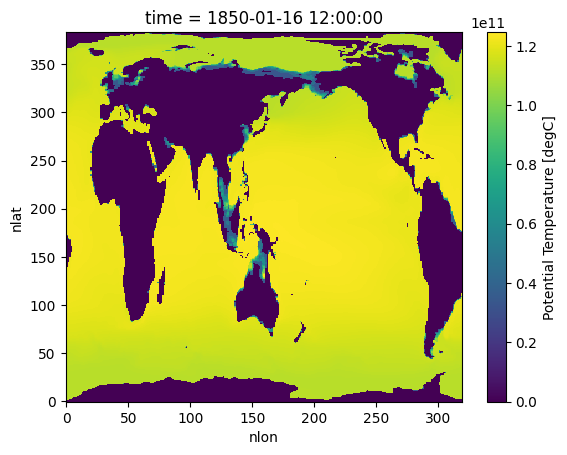
# Jan, 1850 average over all memebers
# hist_ocean_avgheat = hist_ocean_heat.mean('member_id')
hist_ocean_avgheat = hist_ocean_heat.isel({'time':[0,-12]}).mean('member_id')
hist_ocean_avgheat
CPU times: user 34.7 ms, sys: 10.4 ms, total: 45.2 ms
Wall time: 45.7 ms
%%time
hist_ocean_avgheat.isel(time=0).plot()
/home/exouser/.conda/envs/osdf/lib/python3.11/site-packages/distributed/client.py:3387: UserWarning: Sending large graph of size 14.27 MiB.
This may cause some slowdown.
Consider loading the data with Dask directly
or using futures or delayed objects to embed the data into the graph without repetition.
See also https://docs.dask.org/en/stable/best-practices.html#load-data-with-dask for more information.
warnings.warn(
CPU times: user 17.5 s, sys: 2.59 s, total: 20.1 s
Wall time: 2min 37s
%%time
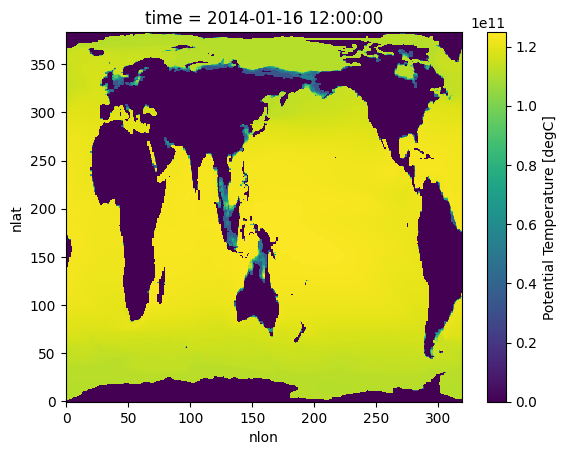
#Plot ocean heat for Jan 2014
hist_ocean_avgheat.isel(time=1).plot()
CPU times: user 17 s, sys: 2.31 s, total: 19.3 s
Wall time: 2min 17s
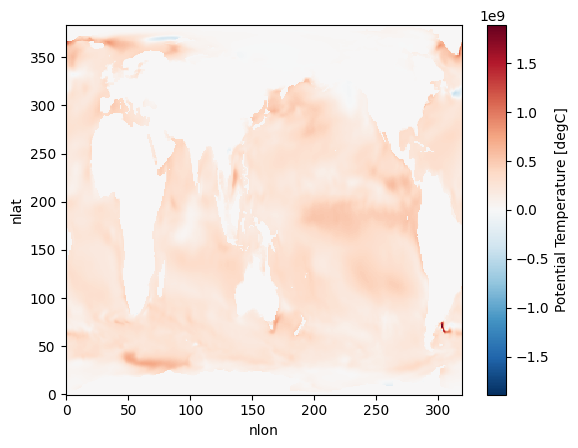
Has the surface ocean heat content increased with time for January ? (Due to Global Warming!)
hist_ocean_avgheat_ano = hist_ocean_avgheat.isel(time=1) - hist_ocean_avgheat.isel(time=0)%%time
hist_ocean_avgheat_ano.plot()/home/exouser/.conda/envs/osdf/lib/python3.11/site-packages/distributed/client.py:3387: UserWarning: Sending large graph of size 14.27 MiB.
This may cause some slowdown.
Consider loading the data with Dask directly
or using futures or delayed objects to embed the data into the graph without repetition.
See also https://docs.dask.org/en/stable/best-practices.html#load-data-with-dask for more information.
warnings.warn(
CPU times: user 18.2 s, sys: 2.65 s, total: 20.9 s
Wall time: 2min 26s
cluster.close()